|
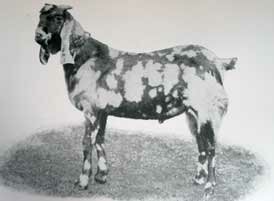
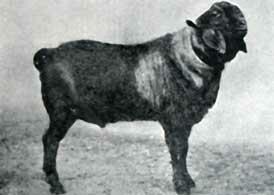
 At the turn of the twentieth century, four males were brought to England. These were N1 Sedgemere Chancellor (Jumna Pari) in 1896, N2 Sedgemere Sangar (Zairaibi) in 1903, N3 Bricket Cross (Chitral district of Pakistan) in 1904 and N4 Bricket Zoo, previously in the Paris Zoo (he was only recognised officially as Nubian in 1913). At the turn of the twentieth century, four males were brought to England. These were N1 Sedgemere Chancellor (Jumna Pari) in 1896, N2 Sedgemere Sangar (Zairaibi) in 1903, N3 Bricket Cross (Chitral district of Pakistan) in 1904 and N4 Bricket Zoo, previously in the Paris Zoo (he was only recognised officially as Nubian in 1913).
1910 the BGS authorised the setting up of a separate Anglo-Nubian section of the Herd Book. The initial entry was limited that were descended from at least one of Chancellor, Sanger or Cross and had no other foreign blood on the dams side for six generations. There were 22 progeny from Chancellor, 69 from Cross out of the 451 goats that were listed. Hence Sedgemere Chancellor and Bricket Cross were the two males, who through their progeny, had the greatest effect on the establishment of the breed.
1915 Miss Pelly started her Theydon herd of Anglo-Nubians. Her goats were high yielding and had very good butterfats. The goat in the Miscellany gallery named Theydon Belle Q*Q*Q*Q*, born in 1930 was the first "four star" Anglo-Nubian. In 1938 the first Anglo-Nubian Q*5 RM2 Theydon Bellaritza was from her herd. The herd gained a high reputation and made a major contribution in the early development.
1925 Malpas Herd was founded by Mr Egerton. After the opening of the probationers record in 1929 he managed to substantial increase in yield by using AN sires. He used some of Miss Pelly's breeding (the male Beau Brocade) on Leazes Decrest (a BA), eventually producing R3 Malpas Magnolia Q* AN from that line. (gave 3,458 lbs milk in 289 days).
1929 Anglo-Nubian Probationers Record opened by the BGS because it was impossible to import further Nubians. It was possible for females to enter this record if three of the four grandparents were AN and the goat passed an inspection by a BGS judge. Once in the register, the use of an Anglo-Nubian male ensured entry in the Anglo-Nubian Record (Register) (later renamed to be Register)
|